Core Day 2026 schedule and program details
Please see each section below for information about Core Day program items. While we anticipate that the listed presentations and posters will be part of Core Day, topics are still subject to change. The final agenda and a detailed program will be released in mid-October.
Core Day takes place in Convocation Hall on Emory University's main campus.
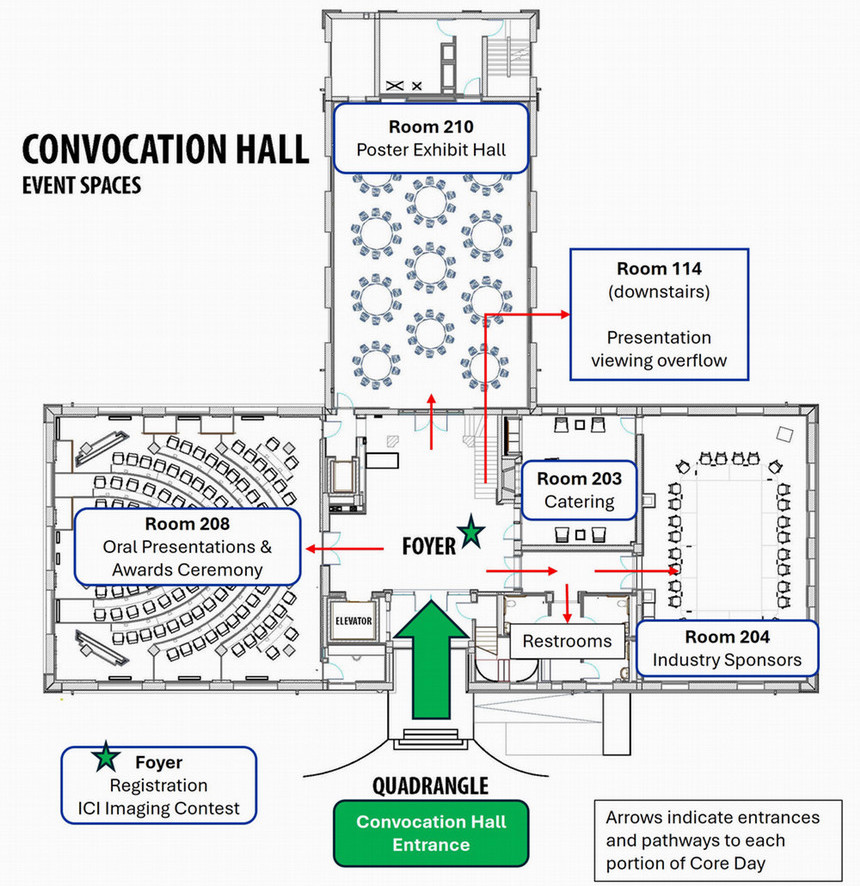
Anticipated Core Day layout in Convocation Hall
10/19 - Core Day program just added!
With just one month to go, we're excited to share the Core Day program (pdf). Please review the program to get details about the Core Day schedule, presentation and poster abstracts, and more information about the ICI imaging contest, Core Awards, and Door Prizes!
Please note that event times may change slightly.
Presentations: Research conducted using EICF cores
New at Core Day 2026! Learn more about how core facilities enable research at Emory. Presentations are listed in alphabetical order by title; expand each section to learn more. Abstracts and additional information are available in the Core Day Program.
Dr. Christopher Neufeldt (Microbiology and Immunology, Emory School of Medicine) conducted research in flaviviruses using complementary confocal and electron microscopy services at the Emory Integrated Cellular Imaging (ICI) and the Robert P. Apkarian Integrated Electron Microscopy (IEMC) cores along with genomics services of the Emory Integrated Genomics Core (EIGC).
Flaviviruses (genus Orthoflavivirus) are arthropod-borne viruses that cause an estimated 400 million human infections annually. All known flaviviruses replicate in association with host endoplasmic reticulum (ER) membranes, where viral genome replication occurs within membrane invaginations termed viral replication organelles (vROs). Here, we used complementary confocal and electron microscopy approaches, including correlative light and electron microscopy (CLEM), to demonstrate that the host ER-shaping protein atlastin-2 (ATL2) is required for the proper organization and function of flavivirus vROs. We further show that ATL2-mediated membrane tethering plays a critical and conserved role in flavivirus replication and that this function can be targeted with synthetic peptides to inhibit infection. This work was enabled by resources and expertise provided by the Emory Integrated Cellular Imaging Core (ICI), the Robert P. Apkarian Integrated Electron Microscopy Core (IEMC), and the Emory Integrated Genomics Core (EIGC).
Keywords: Genetics and genomics, Microscopy, Molecular biology, Omics (e.g., glycomics, lipidomics, metabolomics, proteomics)
Presentation time: 1:15pm
Dr. David Gorkin (Biology, Emory College of Arts and Sciences) used services by the Emory Stem Cell and Organoids Core (ESCOC) and EIGC to develop disease models using induced pluripotent stem cells (iPSC) and generate a brain organoid model.
The BICRA gene encodes a subunit of the BRG1/BRM-associated factor (BAF) family of chromatin remodeling complexes, also known as mammalian SWI/SNF. BICRA is found in a subtype of BAF complexes, called non-canonical BAF (ncBAF). The functions of ncBAF complexes are not well understood, but human genetics points to a critical role for BICRA in brain development. Loss-of-function mutations in BICRA are known to cause a syndromic neurodevelopmental disorder called Coffin Siris Syndrome (OMIM:619325), and BICRA mutations are enriched in patients with diagnoses of Autism and/or developmental delay. To study the mechanisms that link BICRA to brain development and neurodevelopmental disorders, we generated isogenic human induced pluripotent stem cell (iPSC) lines with homozygous and heterozygous null alleles of BICRA (BICRA-/- and BICRA+/-, respectively). We found that BICRA-/- (homozygous) iPSCs maintain pluripotency, but show latent defects of gene regulatory networks involved in pluripotency, and undergo an accelerated course of differentiation upon induction to neural precursor cells (NPCs). Furthermore, we found that NPCs are more sensitive to BICRA gene dosage than iPSCs, as BICRA+/- (heterozygous) cells show defects in gene expression and chromatin accessibility only after induction to NPCs. Together, these findings demonstrate that BICRA is required to stabilize gene regulatory programs which preserve pluripotency and coordinate early stages of neural differentiation. We anticipate that these results will help uncover the mechanisms by which BICRA mutations lead to neurodevelopmental disorders.
Keywords: Behavioral science, Genetics and genomics, Molecular biology, Stem cells
Presentation time: 10:45am
Dr. Candace Fleischer (Radiology and Imaging Sciences, Emory School of Medicine) worked with the Centers for System Imaging Core (CSIC) to perform brain temperature mapping and metabolite imaging via MRI using high magnetic field strengths.
Brain temperature and metabolism are crucial but understudied aspects of brain health. Key challenges in studying the brain with MRI are long scan times, limited spatial and spectral resolution, and the diversity of scanners and software currently used in the clinical setting. My laboratory has developed a suite of tools to facilitate metabolic and thermometric imaging across field strengths, including the first 7 Tesla MRI scanner in the state of Georgia housed at the Center for Systems Imaging. In this talk, I will discuss recent advances in brain imaging and applications to a wide range of diseases including stroke, traumatic brain injury, cancer, and HIV.
Keywords: Biostatistics and/or computation, Clinical Trials, Systems imaging (e.g., MRI, PET)
Presentation time: 10:30am
Dr. Charles Bou-Nader (Biochemistry, Emory School of Medicine), used LCMS services provided by the Emory Glycomics and Molecular Interactions Core (EGMIC) to uncover the mechanism of cGAS activation by DNA-RNA hybrids produced during cellular stress and quantified the production of cGAMP by a series of cGAS variants.
cGAS is an essential innate immune sensor chiefly in charge of activating the immune response during viral infection and controlling anti-tumor immunity by sensing cellular stress. cGAS is typically activated by dsDNA to produce small molecule, specifically a cyclic dinucleotide, called cGAMP to trigger an interferon response. We recently uncovered the mechanism of cGAS activation by DNA-RNA hybrids produced during cellular stress and in close collaboration with the EGMIC core we have quantified the production of cGAMP by a series of cGAS variants. These quantitative mass spectrometry analyses enabled the discovery of novel cGAS variants not responsive to DNA-RNA hybrids yet fully functional for dsDNA-sensing as new molecular tools to study cGAS-mediated inflammation. This unique MS-pipeline can be leveraged to study other cyclic small molecules produced during bacterial and mammalian immunity.
Keywords: Analytical chemistry (e.g., HPLC, mass spectrometry, NMR, X-ray diffraction), Molecular biology
Presentation time: 1:30pm
Dr. Christian Park (Biomedical Engineering, Emory School of Medicine) will present work conducted in Dr. Hanjoong Jo's lab using single-cell RNA sequencing services provided by the Emory Integrated Genomics Core (EIGC).
Atherosclerosis preferentially develops in arterial regions exposed to disturbed flow (d-flow). We tested a two-hit hypothesis in which d-flow initiates partial flow-induced reprogramming of endothelial cells (FIRE), while hypercholesterolemia is required for full FIRE and plaque formation.
Mice received AAV-PCSK9 and Western diet to induce hypercholesterolemia and/or partial carotid ligation to generate d-flow. Single-cell RNA sequencing of carotid arteries at 2 and 4 weeks yielded 98,553 cells from 95 mice. Endothelial reprogramming was validated in EC-specific Confetti lineage-tracing mice, human plaque datasets, and human aortic endothelial cells (HAECs). Plaques developed only when d-flow and hypercholesterolemia were combined. D-flow alone induced partial FIRE, including inflammation, endothelial-to-mesenchymal transition (EndMT), and partial endothelial-to-immune-cell-like transition (partial EndIT). Under hypercholesterolemia, d-flow induced full FIRE, including complete EndIT and a novel endothelial-to-foam-cell-like transition (EndFT). EC-derived foam-like cells showed transcriptomic similarity to foam cells derived from smooth muscle cells and macrophages. Lineage tracing, human plaque analyses, and HAEC studies supported EndIT and EndFT.
Therefore, d-flow initiates partial FIRE, whereas d-flow combined with hypercholesterolemia drives full FIRE and atherogenesis, providing a framework for identifying flow-sensitive mechanisms and therapeutic targets in atherosclerosis.
Keywords: Molecular biology, Omics (e.g., glycomics, lipidomics, metabolomics, proteomics)
Presentation time: 11:15am
Dr. Deanna Kaplan (Family and Preventive Medicine, Emory School of Medicine) worked with the AppHatchery and the Extended Reality Innovation Center (ICER) to develop Fabla, a software platform that allows researchers to study participants daily experience in naturalistic settings.
Health science research has long needed regulatory-compliant tools for capturing spoken reports from participants daily lives. Addressing this need, we developed Fabla (Kaplan et al., 2025), a first-of-its-kind smartphone app for ecological momentary assessment (EMA) that enables researchers to securely collect voice-based, video-based, pictorial, and survey responses from participants as they go about their lives. Using Fabla, participants in research studies provide data about their momentary experiences, symptoms and behaviors as conversationally as trading voice or video messages with a friend. Released by the Georgia CTSA in 2024, Fabla now supports 16 externally funded studies across 4 countries, led by investigators at Emory and beyond, and has earned innovation awards from Genomics Press and the Association for Psychological Science.
Keywords: AI and machine learning, Behavioral science, Clinical Trials
Presentation time: 11:30am
Presentations: GRA Core Exchange partners
Learn about core facilities available at Georgia Research Alliance (GRA) Core Exchange partner institutions. Presentations are listed in alphabetical order by facility; expand each section to learn more. Abstracts and additional information are available in the Core Day program.
Dr. Laxminarayanan Krishnan manages the Micro-CT and Biomechanics core labs at the Georgia Tech Institute for Bioengineering and Bioscience (IBB).
The Georgia Tech IBB administers more than 14 core labs, located across multiple campus spaces, that provide shared access to advanced instrumentation and expertise to enable cutting edge research at Georgia Tech (GT). Access is open to GT faculty, staff and trainees, partner organizations, and industry. Members of the Georgia Core Alliance get easy access to our cores via an existing MoU and enjoy most services and rates at par with GT internal users. Other external entities can utilize specialized service agreements (SSA) to get work done at our core facilities.
This talk will provide a general overview of the IBB Core Research Facilities and highlight some of our core labs including Histology, Microscopy, Cytometry, and Mass spectrometry, among others. The focus will be on the capabilities and examples from the Biomechanics and MicroCT core labs and will cover both instrumentation, and testing and analytical capabilities in these cores.
Presentation time: 1:45pm
Dr. Carla S. Hadden is the Executive Director of Core Facilities (UGA Office of Research) and also serves as the Director of the UGA Center for Applied Isotope Studies.
University of Georgia Core Facilities provide state-of-the-art equipment and services to researchers at UGA and beyond. While offering the full complement of core research services expected at a leading R1 institution, including cytometry, microscopy, and next-generation sequencing, UGA also hosts several nationally distinctive facilities. These include the Animal Health Research Center, one of the nation’s most advanced biocontainment research facilities; the Center for Applied Isotope Studies, home to Georgia's only AMS radiocarbon dating facility and the largest IRMS laboratory in the Southeast; and the state's only university-based scientific glass shop. UGA is also home to the internationally recognized Complex Carbohydrate Research Center, which provides analytical services and hands-on training in glycoscience, glycomics, mass spectrometry, and NMR-based characterization of carbohydrates, proteins, and glycolipids. Additional specialized capabilities include high-performance computing through the Georgia Advanced Computing Resource Center; custom equipment design, fabrication, and repair through the Instrument Design & Fabrication Shop; nanofabrication through the Integrated Bioscience & Nanotechnology Cleanroom; and advanced imaging through Georgia Electron Microscopy lab, including cryo-EM and micro-CT. Thanks to the GRA Core Exchange, Investigators at Emory and other participating institutions can access UGA core facilities at UGA's internal user rates.
Presentation time: 1:00pm
Posters: Core services
Learn more about core services at Emory and other Georgia partner institutions during the Core Services poster session. The poster room will be open throughout Core Day and is a great opportunity to discuss your projects and new opportunities with core personnel! Please see the Core Day program to review abstracts, identify specific times facility staff will be present at the posters, and for a map of the room (map will be added prior to Core Day). Expand the accordion sections for more detail about which facilities will have a poster.
All EICF Cores, the DAR, and Innovation Centers will have a posters on display, these include EICF Cores that are jointly operated with the Winship Cancer Institute.
Winship Shared Resources posters
Cancer Animal Models Shared Resource (CAM)
Cancer Tissue and Pathology Shared Resource (CTP)
Intervention Development, Dissemination, and Implementation (IDDI) Shared Resource
Winship Biostatistics Shared Resource (BSR)
Winship Data and Technology Applications (WinDATA)
Emory + Children's Pediatric Research Cores posters
Animal Physiology Core (AP Core)
CF Discovery Core and CF Biospecimen Repository (CF-BR)
Clinical and Translational Discovery Core (CTDC)
Pediatric Metabolomics and Biomarkers Core (PMBC)
Pediatric Research Development Core
Pediatric Biostatistics Core
Pediatrics/Winship Flow Cytometry Core
ENBRC Cores posters
ENBRC Biomarkers Core
ENBRC Genomics Core
ENBRC Imaging Center
Investigational Clinical Microbiology Core (ICMC)
Medical Informatics and AI Core (MIAI)
Georgia Clinical and Translational Science Alliance (Georgia CTSA)
Institute for Bioengineering and Bioscience (IBB): MicroCT and Biomechanics
Molecular Evolution Core Laboratory: Oligonucleotide & Peptide Synthesis Services
Advanced Translational Imaging Facility (ATIF)
Parking options for Core Day
Core Day is located in Convocation Hall on Emory's main campus in Atlanta, GA. Parking validation will be provided for non-Emory attendees.
Core Day is located in Convocation Hall on Emory's main campus in Atlanta, GA.
- Yes! We can validate visitor parking for non-Emory attendees. Please bring your parking ticket to the Registration table.
- Link to general Emory visitor parking information and click to view a printable Emory Campus parking map
Convocation Hall address: 505 Kilgo Circle, Atlanta, GA
- Please only use the Convocation Hall address for walking directions from your parking location
- Helpful tip: Convocation Hall is across the quad from the Michael C. Carlos Museum
Oxford Road visitor parking: 1390 Oxford Road NE, Atlanta, GA 30307
Preferred: Closest parking to Convocation Hall, less than 10 minute walk (approx. 5-6 minutes)
Parking type: Enclosed/covered parking deck; behind the Emory Barnes & Noble bookstore on Oxford Road. Parking lot has an ADA accessible exit and route to Convocation Hall.
Route to Convocation Hall: Only parking lot with an ADA accessible route to Convocation Hall (take the elevator in the Oxford Road Building to Level 3). Click for suggested walking directions from Oxford Road parking to Convocation Hall
If you do not need an ADA accessible route, or will not be transporting exhibit materials to Core Day, we recommend choosing one of the other lots.
Peavine visitor parking: 29 Eagle Row, Atlanta, GA 30322
Preferred: Less than 10 minute walk to Convocation Hall
Parking type: Uncovered/surface parking lot
Route to Convocation Hall: Stairs and/or steep hills and is not ADA accessible
Click for suggested walking directions from Peavine visitor's lot to Convocation Hall
Fishburne visitor parking: 2003 Fishburne Lane, Atlanta, GA
Less preferred: 10-15 minute walk to Convocation Hall
Parking type: Enclosed/covered parking deck. This deck is not ADA accessible and does not have elevators.
Route to Convocation Hall: The route to Convocation Hall includes some inclines and uneven surfaces, but no steep hills.
Click for suggested walking directions from Fishburne parking to Convocation Hall